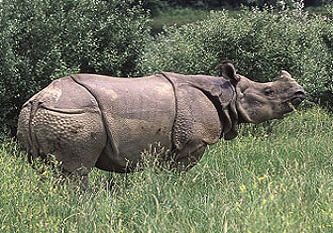
The skin of the Indian rhinoceros is a tarnish ash tone with raised wart-like knocks on the neck, shoulders, and legs and the overlaps looks like protective layers. Its single horn segregates the Indian rhinoceros from its African partners, who have two horns. Subsequently, the Indian rhinoceros are likewise alluded to as the Great One-Horned Rhinoceros. The Indian rhino’s life span is about 35 – 45 years. The bald skin of the Indian rhinoceros is dim or greyish-dark colour and has many free overlaps and protuberances, known as tubercles, giving this species armour-plated appearance. The male Indian rhino, which is usually larger than its female counterparts, has huge, sharp incisors that are used utilised to fight battles to get females amid the reproducing season.
The Indian rhino is bound to the tall prairies and woodlands in the foothills of the Himalayas in India. The Indian Rhino's living space is tropical and subtropical meadows, savannas, bush terrains, marshes and woodlands – like that of the White rhino. To battle the warmth, the rhinos eat during the cooler parts of the day and submerge themselves in close-by waterways and mud gaps amid the hot time of the day. Even though they weigh up to 2200 kg (4800 lb.), one-horned rhinoceroses are known to be great swimmers.
The Indian rhino is the second biggest rhinoceros, next just to the white rhino. They are famous by the name one-horned rhinoceroses, as they have just a single horn. The single horn is made of keratin, a similar material found in the hair and nails of people. The horn can develop as vast as sixty centimetres in length. Dissimilar to the highly contrasting rhinos, the Indian rhino can utilise its horn during battle in any manner. The Indian rhino can develop back its horn; however, it is a moderate procedure. Rhinoceroses have poor visual perception, but they compensate for it with their excellent hearing and feeling of smell. In fact, they utilise their improved feeling of smell to search out different rhinos amid the mating season.
India is rich in flora and fauna, and Jim Corbett is one perfect place to get closest to nature.
? FAQs – Indian Rhinoceros (Greater One-Horned Rhino)
1. What is the Indian rhinoceros?
The Indian rhinoceros (Rhinoceros unicornis), also called the Greater One-Horned Rhinoceros, is a large mammal known for its single horn and thick, armour-like skin folds.
2. How many horns does an Indian rhinoceros have?
It has only one horn on its snout, unlike African rhinos which have two.
3. What does the horn consist of?
The rhino’s horn is made of keratin, the same material as human hair and nails.
4. How big and heavy are Indian rhinos?
They are one of the largest rhino species — adults can weigh up to around 2,200 kg (4,800 lb) and measure over 3 m (10 ft) in length.
5. What does their skin look like?
Their skin is dark grey with loose folds and wart-like bumps, giving the appearance of natural armor.
6. Where do Indian rhinos live?
They inhabit tropical and subtropical grasslands, floodplains, savannas, and forests in northern India and Nepal.
7. What kind of habitat do they prefer?
Indian rhinos favour grasslands and wetlands near rivers, often in the foothills of the Himalayas and river valleys.
8. What do Indian rhinos eat?
They are herbivores, mainly grazing on grasses, but also eating leaves, fruits, and aquatic plants.
9. How long do they live?
Indian rhinos typically live about 35–45 years in the wild.
10. Are Indian rhinos good swimmers?
Yes — despite their size, they are excellent swimmers and often wallow in water or mud to cool off.
11. How do their senses compare to humans?
They have poor eyesight but make up for it with strong hearing and a keen sense of smell.
12. Do both male and female rhinos have horns?
Yes — both sexes grow a horn, though males generally have larger horns.
13. How do rhinos use their horn?
They rarely use the horn for fighting; instead, males often use their sharp lower teeth in battles during breeding season.
14. What threats do Indian rhinos face?
Historically they were nearly extinct due to poaching and habitat loss, but conservation efforts have increased their numbers significantly.
15. Is the Indian rhino’s population increasing?
Yes — strong protection and management have helped populations rebound, making them a conservation success in parts of India and Nepal.
16. Can rhino horns regrow?
Yes — their horn can regrow after breakage, although this is a slow process.
17. Why are Indian rhinos ecologically important?
As megaherbivores, they help shape grassland ecosystems and aid in seed dispersal, contributing to biodiversity.